
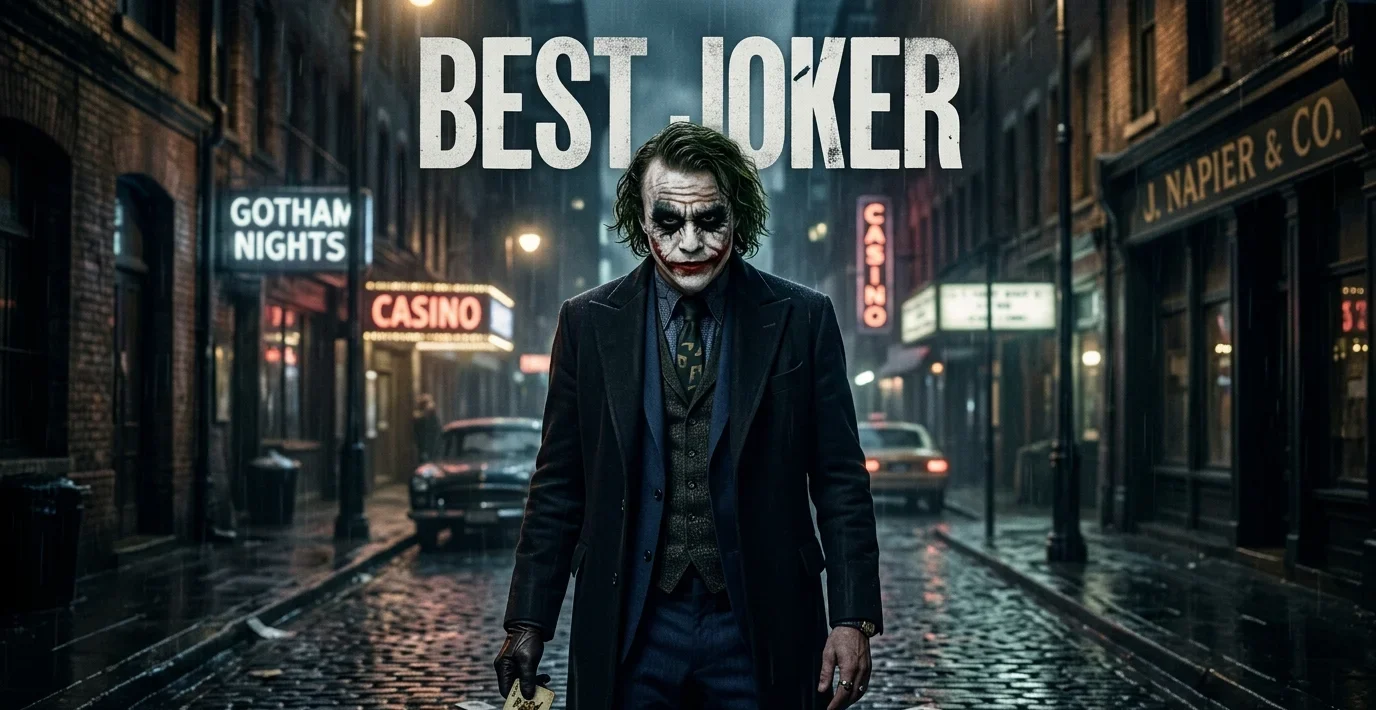

Few comic-book characters have been reinvented as often as Batman’s most famous enemy. The best Joker depends partly on what you value: menace, humor, psychological depth, comic accuracy, or sheer entertainment. For American audiences comparing the major portrayals, Heath Ledger, Mark Hamill, Jack Nicholson, and Joaquin Phoenix remain essential starting points.
Quick answer: Heath Ledger’s performance in The Dark Knight is our top live-action choice because it combines menace, unpredictability, writing, and lasting cultural impact. Mark Hamill is the strongest animated interpretation, while Jack Nicholson remains a defining classic. Joaquin Phoenix offers the most character-focused version rather than a traditional Batman villain.
| Rank | Performer | Major Appearance | What Makes the Version Stand Out |
|---|---|---|---|
| 1 | Heath Ledger | The Dark Knight | Menacing, unpredictable, culturally influential |
| 2 | Mark Hamill | Batman: The Animated Series | Definitive voice, humor, range |
| 3 | Jack Nicholson | Batman | Theatrical, funny, threatening |
| 4 | Joaquin Phoenix | Joker | Psychological character study |
| 5 | Cameron Monaghan | Gotham | Long-form character development |
| 6 | John DiMaggio | Batman: Under the Red Hood | Brutal, sarcastic performance |
| 7 | Cesar Romero | Batman | Colorful, comic, historically important |
| 8 | Alan Tudyk | Harley Quinn | Modern comedy mixed with cruelty |
| 9 | Jared Leto | Suicide Squad | Gangster-inspired reinvention |
What Makes a Great Joker?
A strong version needs more than green hair, white makeup, and a memorable laugh. The character works because he can shift between comedy and danger without becoming predictable. His relationship with Batman also gives his actions more meaning than a standard movie villain’s. That rivalry matters for every actor who plays the hero too, including Robert Pattinson, whose Batman needs a villain worth fighting.
The strongest portrayals approach those qualities in different ways. Ledger emphasizes chaos, Hamill moves effortlessly between jokes and threats, while Nicholson turns criminal showmanship into spectacle. Phoenix takes another route by building an entire film around a troubled man who eventually assumes the familiar identity.
That flexibility has existed since the character’s earliest years. The villain first appeared in Batman #1 in 1940 and quickly became one of Batman’s defining enemies. Decades of comics, movies, television, animation, and games have since allowed creators to reinterpret the same basic character.
1. Heath Ledger, The Dark Knight
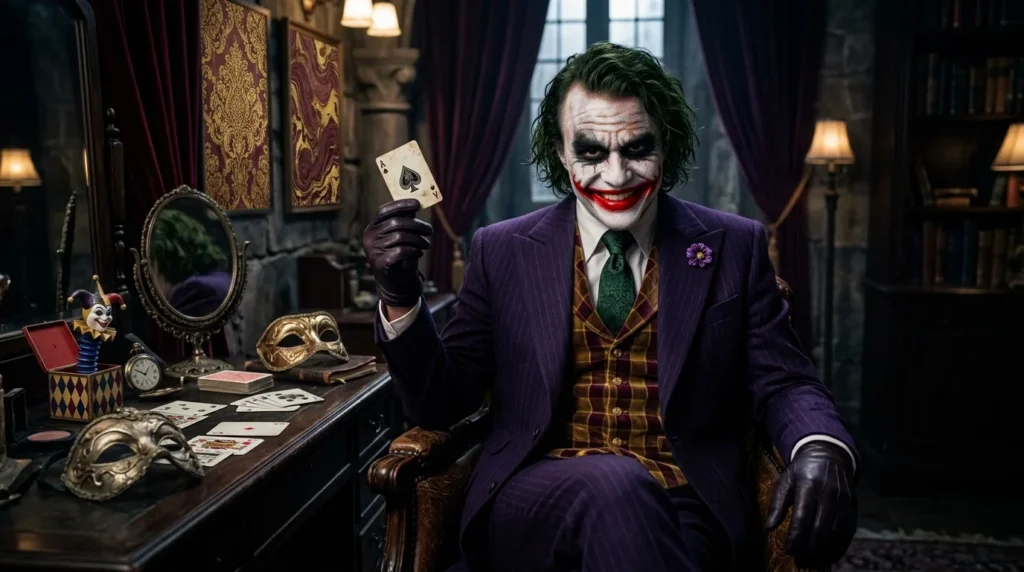
Heath Ledger takes the number-one spot because his performance works on almost every level. His character is frightening without relying on supernatural powers, and his shifting stories make his history impossible to pin down. Every conversation can turn violent without warning.
Christopher Nolan’s The Dark Knight also gives the character a clear purpose. He wants to challenge Batman’s belief in rules and expose how ordinary people behave under pressure. That conflict makes him more than an obstacle that Batman must defeat.
Ledger won the Academy Award for Best Supporting Actor for the role after his death. The honor reflects the performance’s significance beyond superhero fandom. More importantly for viewers, the portrayal remains distinctive even after many later comic-book villains borrowed elements from it.
Pros
- Exceptional tension and unpredictability.
- Strong philosophical conflict with Batman.
- Memorable physical and vocal performance.
- Works within a grounded crime-film setting.
Cons
- Less visually faithful to some traditional comic versions.
- Viewers wanting a playful clown may find this interpretation too dark.
2. Mark Hamill, Batman: The Animated Series
Mark Hamill proves that a performer never needs to appear on camera to define a character. His voice work in Batman: The Animated Series can sound playful in one moment and genuinely threatening seconds later. That range makes his interpretation unusually close to the villain’s comic-book flexibility.
The animated format also gives this version room for absurd schemes and exaggerated comedy. Those elements never fully erase the danger underneath. Hamill therefore captures something several darker interpretations lose: this villain is supposed to be funny at times.
For viewers who grew up with DC animation, Hamill may be the most recognizable voice associated with the character. His work continued across other animated productions and games. That longevity helped shape how generations of fans expect the character to sound.
Pros
- Exceptional vocal range.
- Balances humor and danger.
- Fits classic Batman stories naturally.
- Decades of material to watch.
Cons
- The voice performance may not satisfy viewers who compare it only to live-action actors.
- Different animated projects vary in tone.
3. Jack Nicholson, Batman
Jack Nicholson’s performance in Tim Burton’s 1989 Batman helped define the character for a generation. His version is a criminal showman who enjoys being the center of attention. Nicholson mixes gangster confidence with theatrical comedy and sudden violence.
The visual design also remains memorable. The bright clothing, permanent grin, and elaborate schemes embrace the comic-book origins more openly than later realistic adaptations. Burton’s stylized Gotham gives Nicholson enough room to make those wider choices feel natural.
This portrayal works especially well for viewers who want the villain to be entertaining as well as dangerous. Nicholson does not disappear into grim realism. He makes every entrance feel like part crime scene and part performance.
Pros
- Strong comic-book visual identity.
- Funny without becoming harmless.
- Excellent match for Burton’s Gotham.
- Major influence on later screen interpretations.
Cons
- Less psychologically complex than several modern versions.
- Some elements feel tied to late-1980s blockbuster filmmaking.
4. Joaquin Phoenix, Joker
Joaquin Phoenix offers the most unusual interpretation on this list. Joker focuses on Arthur Fleck before he becomes the famous criminal figure, making the story more personal than a traditional Batman adventure. The movie focuses primarily on Arthur’s isolation, choices, and transformation.
Phoenix’s physical performance is central to that approach. His posture, movement, dancing, and facial expressions communicate changes that dialogue sometimes leaves unstated. The result feels intentionally different from the confident criminal masterminds seen in other adaptations.
Phoenix won the Academy Award for Best Actor for the performance. Still, viewers searching for a classic Batman-versus-villain story should know that this interpretation serves another purpose. It works best as a standalone character study rather than a conventional version of Gotham’s criminal mastermind.
Pros
- Detailed physical performance.
- Unusual character-centered approach.
- Strong standalone identity.
- Academy Award-winning lead performance.
Cons
- Limited connection to a traditional Batman rivalry.
- Less representative of the classic comic-book personality.
5. Cameron Monaghan, Gotham
Cameron Monaghan gets something movie performers rarely receive: time. Across Gotham, he explores different sides of the familiar archetype through Jerome and Jeremiah Valeska. The extended television format lets the performance change as Gotham itself grows stranger.
Monaghan can be energetic and theatrical, but he can also become cold and controlled. That contrast keeps his appearances from feeling like an imitation of a previous actor. His work borrows recognizable ingredients while developing its own television identity.
The main drawback is straightforward. The series approaches the mythology indirectly instead of presenting a conventional version under the famous name. Still, fans interested in a long-form interpretation will find more character development here than most two-hour films can provide.
6. John DiMaggio, Batman: Under the Red Hood
John DiMaggio’s performance in Batman: Under the Red Hood deserves more attention from casual viewers. His voice is rougher and heavier than Hamill’s, which gives this version an immediately different presence. His comedy also carries an aggressive edge.
That tone fits the story because the character’s past violence has direct consequences for Batman and Jason Todd. He isn’t there merely to deliver jokes or set another elaborate trap. His actions sit at the center of the movie’s emotional conflict.
DiMaggio also avoids sounding like a copy of more famous performers. That matters because the role can tempt actors toward familiar laughs and speech patterns. His version instead feels comfortable being ugly, cruel, and strangely amusing at the same time.
7. Cesar Romero, Batman
Cesar Romero represents an earlier era of superhero entertainment. His colorful performance in the 1960s Batman television series embraces elaborate crimes, jokes, and theatrical villainy. It is far removed from the disturbing interpretations that later became common.
That difference is precisely why the performance remains worth watching. Romero shows that the character can function as a mischievous comic villain without losing his recognizable identity. His energy also matches the deliberately exaggerated style surrounding Adam West’s Batman.
Modern viewers should approach the performance within that context. It was never designed to compete with realistic crime dramas. As a piece of Batman history, however, Romero’s interpretation remains charming and influential.
8. Alan Tudyk, Harley Quinn
Alan Tudyk’s work in the animated Harley Quinn series puts comedy near the center. His version can be petty, ridiculous, selfish, and dangerous within the same episode. That mixture suits a show that regularly turns familiar DC characters into targets of satire.
The humor does not completely remove his threatening side. Instead, the series uses the contrast to make sudden cruelty more noticeable. Tudyk also benefits from material that examines the character outside his usual obsession with Batman.
This interpretation is a strong choice for adults wanting a modern animated comedy. It is less suitable for viewers seeking a serious crime story. Within the show’s tone, though, the performance understands exactly what it needs to accomplish.
9. Jared Leto, Suicide Squad
Jared Leto’s version in Suicide Squad tries to separate itself visually from previous portrayals. Tattoos, jewelry, expensive cars, and a modern gangster aesthetic replace the traditional purple-suited criminal image. That makes his interpretation immediately recognizable.
The problem is that the theatrical movie gives him limited room to develop the character. Much of his screen time also connects directly to Harley Quinn rather than a larger conflict with Batman. As a result, audiences see the style more clearly than the character underneath it.
Leto later appeared again in Zack Snyder’s Justice League, where the different setting offered another glimpse at his approach. His performance remains one of the most divisive modern interpretations. It is still useful when comparing how far filmmakers can redesign a familiar villain.
Best Joker by Category
Different performances succeed for different reasons, so no single ranking can satisfy every viewing preference. Someone seeking animation will probably value different qualities than a viewer choosing a dark crime movie. These category picks make the decision easier.
- Best live-action performance: Heath Ledger.
- Best animated performance: Mark Hamill.
- Best classic movie version: Jack Nicholson.
- Best standalone character study: Joaquin Phoenix.
- Best television interpretation: Cameron Monaghan.
- Best comedic modern version: Alan Tudyk.
If you are building a Batman watchlist, start with The Dark Knight, Batman: The Animated Series, and Burton’s Batman. Those three show how differently the same villain can function across realistic drama, animation, and stylized comic-book filmmaking.
Why Heath Ledger Ranks as the Best Joker
Our best Joker pick is Heath Ledger because the performance balances character, story, threat, and influence better than the alternatives. He is frightening, but the writing also gives him ideas that directly challenge Batman. The movie never needs to provide a definitive origin to make him compelling.
Ledger also benefits from appearing opposite Christian Bale’s established Batman. Their conflict gives both characters opportunities to test their beliefs through action rather than exposition. The result remains easy to recommend to viewers who want one essential performance.
Mark Hamill is the closest alternative because his animated work captures a broader range of the character. Nicholson offers more theatrical fun, while Phoenix focuses more on one man’s transformation. Your favorite can reasonably change depending on which of those qualities matters most.
Frequently Asked Questions
Who is the best Joker of all time?
Heath Ledger is our top choice because his performance in The Dark Knight combines menace, unpredictability, strong writing, and cultural impact. Mark Hamill is an equally important choice for animation fans. Both interpretations helped define expectations for later versions.
Which actors won Oscars for playing the Joker?
Heath Ledger won the Academy Award for Best Supporting Actor for The Dark Knight. Joaquin Phoenix later won Best Actor for Joker. Their performances are dramatically different, which demonstrates how flexible the role can be.
Is Heath Ledger or Joaquin Phoenix better as the Joker?
They are difficult to compare because their movies pursue different goals. Ledger plays an established criminal who challenges Batman, while Phoenix plays Arthur Fleck in a standalone, origin-focused story. Viewers who want Batman conflict may prefer Ledger, while those who want a character study may prefer Phoenix.
Who is the best animated Joker?
Mark Hamill is our leading animated choice because of his vocal range and long association with the role. His performance can move from comedy to menace without losing the character’s personality. John DiMaggio and Alan Tudyk provide strong alternatives with distinctly different styles.
Who played the first Joker?
The character first appeared in DC’s Batman #1 in 1940. Cesar Romero later became the first actor to play him in live-action television through the 1960s Batman series. His colorful approach remains an important part of the character’s screen history.
The Final Takeaway
No single interpretation represents every side of Batman’s greatest enemy. Heath Ledger delivers our strongest live-action performance, while Mark Hamill remains the animated standard for viewers who value humor and range. Nicholson, Phoenix, and the other performers prove that radically different approaches can still produce memorable results.
Start with The Dark Knight if you want the clearest single recommendation. Then watch Hamill’s animated episodes and Nicholson’s Batman to see how flexible the character can be. For more entertainment and actor coverage, explore Scriify’s entertainment articles, including its features on Robert Pattinson and Matthew Tyler Vorce.
